
Disagree · Negotiate · Repair
Learn Constructive Conflict
Constructive conflict is the capacity to surface disagreement, regulate intensity, understand interests and power, challenge ideas without demeaning people, negotiate workable next steps and repair trust when harm occurs.
Builds your Connection capability.
Start here · one first move
Choose a real, proportionate disagreement and write the issue without motive or identity labels.
Field guide 11
Understand
A working definition
In practice
Names the issue without attacking identity, represents other views accurately, makes interests and power discussable, voices concern clearly, and closes with an agreement, boundary or next experiment.
Why this matters now
AI transformation creates real disagreements about quality, risk, identity and workload. Teams need the capacity to challenge automated recommendations and leadership assumptions before silent resistance becomes failure.
It is
- Direct and relationship-aware.
- Able to hold legitimate difference.
- Concerned with interests, power and impact.
- Committed to follow-through and repair.
It is not
- Avoiding tension to preserve surface harmony.
- Winning, dominating or humiliating.
- Compromising when safety or rights are at stake.
- Assuming every conflict can be fully resolved.
The capability loop
Conflict can become information.
The goal is not emotional flatness or forced agreement. It is safer truth, workable action and appropriate repair.
- 1
Pause
What intensity, safety or timing needs attention first?
- 2
Name
What specific issue, behavior or impact is in conflict?
- 3
Understand
What interests, needs, histories and power shape each view?
- 4
Create
What options, boundaries or experiments could move the issue?
- 5
Commit
What is agreed, unresolved, owned and ready for review or repair?
Go deeper
The full field guide
8 connected capabilities+
Constructive conflict combines truth, regulation, perspective, power, negotiation and repair.
- Conflict recognition
- Notices tension, avoidance and early escalation signals.
- Emotional regulation
- Manages intensity without suppressing important information.
- Perspective accuracy
- Represents another view fairly before challenging it.
- Interest exploration
- Looks beneath positions for needs, values and constraints.
- Courageous expression
- Voices concern, boundary and evidence directly.
- Power awareness
- Recognizes status, safety and unequal ability to refuse.
- Negotiation
- Generates options and workable mutual commitments.
- Repair and follow-through
- Addresses harm and checks whether agreements work.
The components strengthen one another. Development depends on how they are combined in context—not on maximizing one behavior in isolation.
Behaviour map+
01
Before
- Check safety Assesses timing, power, intensity and support needs.
- Define the issue Names the behavior, decision or impact at stake.
- Test the story Separates observation from assumption about motive.
- Choose the purpose Clarifies what a useful conversation should change.
02
During
- Represent fairly States the other view in a way they recognize.
- Voice directly Uses specific evidence, impact, need and boundary.
- Explore interests Asks what matters underneath the stated position.
- Create options Generates alternatives before forcing closure.
03
After
- Record agreement Names decisions, owners, boundaries and unresolved points.
- Check impact Returns to whether the agreement works in practice.
- Repair harm Acknowledges effect and restores dignity where possible.
- Learn the pattern Changes conditions that repeatedly produce the conflict.
Case story · composite+
When nobody challenges the AI transformation plan.
The conflict was already present.
The challenge.
A leadership team presents an aggressive AI rollout.
In the meeting everyone agrees, but afterward experts warn privately that quality controls, workload and professional responsibility are unresolved. 1 · Pause The sponsor creates a second conversation with explicit protection for responsible dissent. 2 · Name The group separates disagreement about pace, evidence, role impact and decision authority. 3 · Understand Leaders hear that silence reflected status and deadline pressure, not genuine agreement. 4 · Create The team designs staged pilots, quality gates, workload limits and an escalation route. 5 · Commit Owners, unresolved risks and review dates are documented, and earlier silencing is acknowledged.
Capability in practice The conflict was already present.
Making it discussable prevented false alignment from becoming operational harm.
Leadership and learning culture+
- Model Invite challenge and show how evidence can change your view.
- Protect Separate responsible dissent from disloyalty or low commitment.
- Design Use clear rounds, independent input and escalation routes.
- Address Name power, exclusion and repeated patterns instead of demanding harmony.
- Repair Return to harm, broken agreements and trust after the immediate decision.
Why we protect this skill — HI · FRI · IMPACT+
Human Core
How central should human agency, judgment and responsibility remain?
uman owns
▰▰▰▰▰
Future Readiness
How strongly does this help people learn and act as roles and technology change?
Foundational
▰▰▰▰▰
Safeguard Value
How strongly does this protect capability from over-reliance, deskilling and loss of agency?
Critical safeguard
▰▰▰▰▰
They describe why the capability matters—not how advanced a learner is. AI can summarize positions or suggest scripts. People must create safety, name power, decide boundaries, hear impact and repair trust in the living relationship.
Practice
Have the BRAVE conversation.
Use this short structure in real work, reflection or coaching. Keep the action specific enough to observe.
- B
Bring it forward
What specific issue, behavior or impact needs discussion?
- R
Represent fairly Can
I state the other view in a way they recognize?
- A
Ask underneath
Which needs, values, fears or constraints drive the positions?
- V
Voice clearly
What evidence, concern, need or boundary must I state?
- E
Establish next
What is agreed, unresolved, owned and ready for review?
One-minute start: “The issue I want us to examine is ... The impact I see is ... What am I missing?” The protocol supports practice. It does not remove the need for context, expertise, ethical judgment or appropriate human support.
Seven-day experiment
Practise one constructive disagreement.
0 of 7 days marked · saved on this device
Prove it
Five stages of constructive disagreement.
The progression describes observable conflict behavior - not agreeableness, emotional style, cultural conformity or willingness to tolerate harm.
L1
Notice
Recognizes obvious tension and uses support to pause escalation or avoidance.
L2
Express
Names a familiar concern or need without attacking the person.
L3
Explore
Listens accurately, identifies interests and generates several options.
L4
Negotiate
Works with power, uncertainty and high stakes to build clear commitments.
L5
Facilitate
Creates conditions for dissent, mediation, repair and collective learning.
Use the progression well Ask for the next observable behavior—not a label for the person.
Ask Markku-AI about Constructive Conflict
Markku-AI is trained on Markku Pelkonen's own work: life skills, future-readiness, and how any skill actually develops. Ask it about a skill you want to build. For questions about how this website works, the answers above are better.
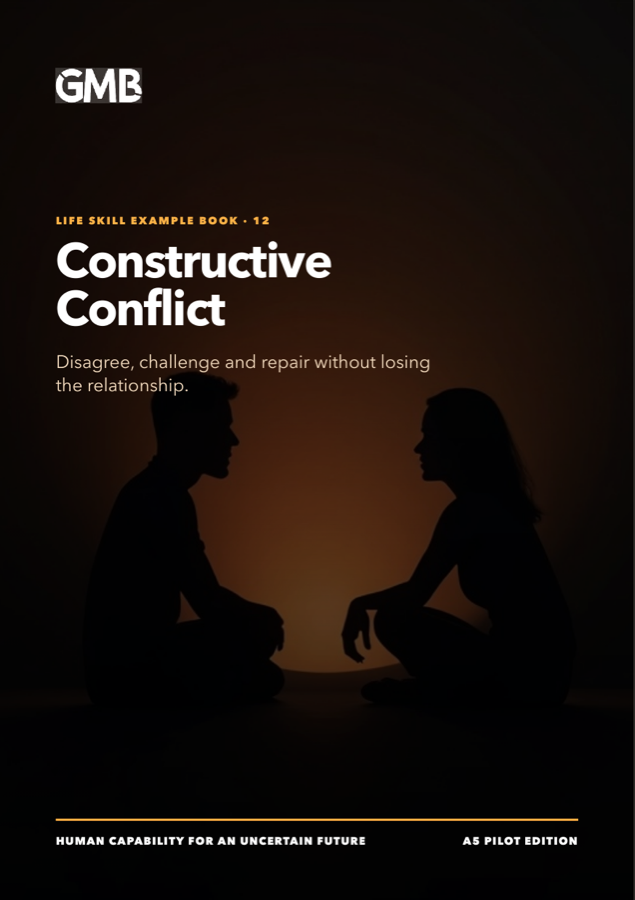
Read the full minibook
Constructive Conflict
The printed A5 field guide — same content, typeset for paper.
Next step
Put this skill into practice
Reading changes what you notice. Practice changes what you do. The seven-day sprint turns one behaviour into a habit.