
Imagine · Reframe · Act
Learn Futures Literacy
Futures literacy is the capacity to notice how assumptions about the future shape the present, imagine multiple plausible and desirable futures, explore their implications, and use that range to improve choices and experiments now.
Builds your Adaptability and AI Fluency capability.
Start here · one first move
Choose a real strategic question and set a meaningful time horizon.
Field guide 07
Understand
A working definition
In practice
Scans signals, reveals hidden assumptions, creates contrasting futures, examines consequences and rehearses present actions without treating any scenario as a prediction.
Why this matters now
AI systems can generate forecasts and scenarios at great speed. Futures literacy helps people question the assumptions inside them and avoid letting one probable story narrow present-day imagination and agency.
It is
- A disciplined use of imagination.
- Comfortable with multiple possible futures.
- Explicit about assumptions and uncertainty.
- Connected to decisions and experiments now.
It is not
- Predicting the one correct future.
- Trend lists without implication or action.
- Optimism, pessimism or science fiction alone.
- Using dramatic scenarios to manufacture certainty.
The capability loop
Use the future to see the present differently.
The future does not yet exist. Its value lies in how different imagined futures reveal assumptions, choices and possibilities now.
- 1
Observe
Which signals, changes and persistent forces matter?
- 2
Reveal
What future are we already assuming or treating as inevitable?
- 3
Imagine
What contrasting plausible, possible and desirable futures can we create?
- 4
Explore
What would each future mean for people, systems and decisions?
- 5
Act now
What robust move, option or experiment improves readiness today?
Go deeper
The full field guide
8 connected capabilities+
Futures literacy connects signals, assumptions, imagination, implications and present agency.
- Signal sensing
- Notices emerging change and persistent structural forces.
- Assumption awareness
- Makes implicit expectations about the future visible.
- Multiple-futures imagination
- Creates contrasting possibilities instead of one forecast.
- Uncertainty literacy
- Works with ambiguity without pretending that all futures are equally likely.
- Systems connection
- Explores how changes interact across people and institutions.
- Implication exploration
- Examines what scenarios would mean for choices and capabilities.
- Scenario use
- Uses future stories as learning devices, not predictions.
- Anticipatory action
- Builds options, experiments and readiness in the present.
The components strengthen one another. Development depends on how they are combined in context—not on maximizing one behavior in isolation.
Behaviour map+
01
Before
- Set the horizon Chooses a timeframe far enough to expose change.
- Scan broadly Looks across social, technological, ecological, political and economic signals.
- Name the default Writes the future the current plan assumes.
- Invite imagination Includes people whose futures are often decided by others.
02
During
- Build contrasts Creates futures that differ in meaningful drivers and values.
- Separate likelihood Distinguishes plausible, possible, probable and preferred.
- Explore implications Asks what each future changes for capability, identity and risk.
- Look backward Identifies what would need to happen for each future to emerge.
03
After
- Find robust moves Selects actions useful across more than one future.
- Preserve options Avoids irreversible commitment when uncertainty is high.
- Run experiments Tests assumptions through present-day learning moves.
- Renew the set Updates scenarios as signals, values and conditions change.
Case story · composite+
When one AI forecast freezes the workforce strategy.
The scenarios did not predict headcount.
The challenge.
A company forecast predicts rapid automation and large role reductions.
Leaders treat the scenario as inevitable, pause development investment and trigger fear across the organization. 1 · Observe The team separates current evidence, vendor assumptions and genuine uncertainty. 2 · Reveal They name the default story: automation substitutes tasks, and capability investment therefore loses value. 3 · Imagine Four futures vary adoption speed, regulation, job redesign, customer trust and human-AI complementarity. 4 · Explore Each scenario reveals different needs for judgment, mobility, wellbeing and learning infrastructure. 5 · Act now Leadership funds role experiments and transferable skills that create value across several futures.
Capability in practice The scenarios did not predict headcount.
They reopened choices that one confident forecast had closed.
Leadership and learning culture+
- Signal Create regular space to notice change beyond the usual industry lens.
- Include Broaden who imagines the future and whose consequences count.
- Vary Require strategically different scenarios, not optimistic and pessimistic versions.
- Test Use scenarios to rehearse decisions, identity, capability and ethics.
- Invest Protect options and experiments that remain useful across multiple futures.
Why we protect this skill — HI · FRI · IMPACT+
Human Core
How central should human agency, judgment and responsibility remain?
uman leads
▰▰▰▰▱
Future Readiness
How strongly does this help people learn and act as roles and technology change?
Foundational
▰▰▰▰▰
Safeguard Value
How strongly does this protect capability from over-reliance, deskilling and loss of agency?
Strong safeguard
▰▰▰▰▱
They describe why the capability matters—not how advanced a learner is. AI can generate scenarios and detect patterns. Humans must decide which futures matter, whose imagination is included and what present choices preserve responsible possibility.
Practice
SHIFT the future frame.
Use this short structure in real work, reflection or coaching. Keep the action specific enough to observe.
- S
Scan signals
What may be changing, persisting or interacting?
- H
Hold multiples
Which contrasting futures should remain thinkable?
- I
Identify assumptions
What does the current plan treat as inevitable?
- F
Find implications
What would each future change for people and choices?
- T
Test now
What robust action or experiment increases readiness today?
One-minute start: “The future our plan assumes is ... Another plausible future is ... A robust move now is ...” The protocol supports practice. It does not remove the need for context, expertise, ethical judgment or appropriate human support.
Seven-day experiment
Use three futures in seven days.
0 of 7 days marked · saved on this device
Prove it
Five stages of using the future.
The progression describes how a person uses imagined futures to improve present action - not prediction accuracy or confidence about what will happen.
L1
Extend
Looks beyond the immediate horizon and names a simple possible consequence.
L2
Compare
Recognizes that more than one future could emerge from present conditions.
L3
Explore
Builds contrasting scenarios from signals, assumptions and uncertainties.
L4
Reframe
Uses scenarios to challenge strategy, identity and taken-for-granted constraints.
L5
Convene
Helps diverse groups imagine, learn and build robust options together.
Use the progression well Ask for the next observable behavior—not a label for the person.
Ask Markku-AI about Futures Literacy
Markku-AI is trained on Markku Pelkonen's own work: life skills, future-readiness, and how any skill actually develops. Ask it about a skill you want to build. For questions about how this website works, the answers above are better.
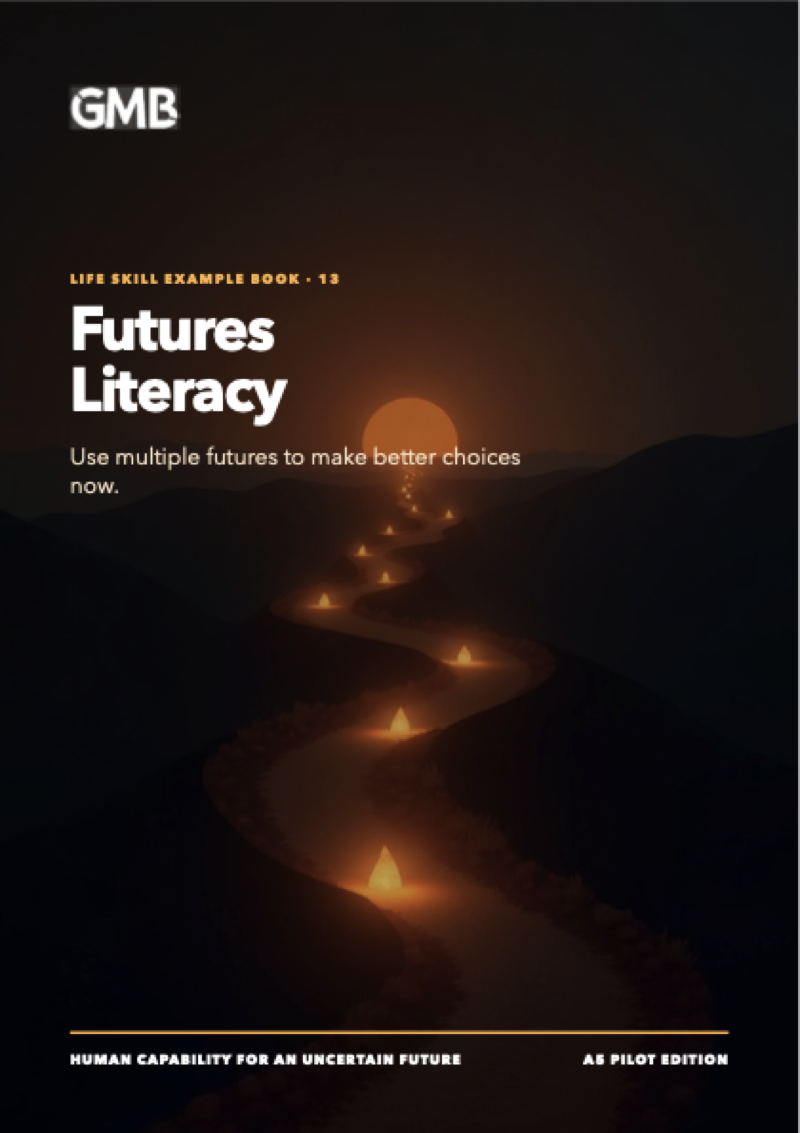
Read the full minibook
Futures Literacy
The printed A5 field guide — same content, typeset for paper.
Next step
Put this skill into practice
Reading changes what you notice. Practice changes what you do. The seven-day sprint turns one behaviour into a habit.