
Direction · Meaning · Contribution
Learn Purpose
Purpose is an evolving, beyond-self direction that connects values and strengths to meaningful contribution and guides choices across time.
Builds your Learning Agility capability.
Start here · one first move
Record three moments that felt meaningful, empty or morally important.
Field guide 13
Understand
A working definition
In practice
Names what matters, who or what the work serves, chooses in alignment and revisits direction when life or context changes.
Why this matters now
When roles, tools and identities change quickly, purpose helps people decide what is worth learning, preserving, changing and contributing.
It is
- A direction, not a destination.
- Personal and connected beyond the self.
- Expressed through choices.
- Able to evolve.
It is not
- One perfect calling.
- A corporate slogan.
- Constant passion or certainty.
- A reason to tolerate harmful conditions.
The capability loop
Purpose becomes real through alignment.
Meaning is discovered and constructed through attention, choice and contribution.
- 1
Listen
When do energy, care, anger or aliveness signal what matters?
- 2
Name
Which values, strengths and relationships are central?
- 3
Imagine
What contribution or future direction feels worth serving?
- 4
Align
Which present choices move toward—or away from—that direction?
- 5
Renew
What has changed, and how should purpose evolve?
Go deeper
The full field guide
8 connected capabilities+
Purpose is an orientation system, not a fixed answer.
- Direction clarity
- Holds an overarching sense of where to move.
- Meaning recognition
- Notices what creates significance and aliveness.
- Beyond-self orientation
- Connects personal direction to contribution.
- Values alignment
- Uses values to guide real trade-offs.
- Goal integration
- Links daily activity to larger aims.
- Purpose articulation
- Expresses direction clearly enough to guide action.
- Resilience through purpose
- Draws strength from what remains worth serving.
- Purpose evolution
- Lets direction deepen as experience and context change.
The components strengthen one another. Development depends on how they are combined in context—not on maximizing one behavior in isolation.
Behaviour map+
01
Before
- Name what matters Identifies values, people and outcomes at stake.
- Define contribution Clarifies who or what the choice should serve.
- Check the horizon Connects the decision to longer-term direction.
- Notice tension Makes conflicting values or roles visible.
02
During
- Use purpose as a filter Compares options against meaning and contribution.
- Choose the trade-off Accepts that alignment can require saying no.
- Stay connected Keeps affected people present in the decision.
- Act concretely Turns direction into one observable commitment.
03
After
- Review alignment Compares intention with lived action.
- Notice impact Checks whether contribution reached others.
- Learn from friction Uses discomfort to refine values or boundaries.
- Renew direction Updates purpose without abandoning continuity.
Case story · composite+
When automation changes the role—but not the contribution.
Purpose did not preserve the old role.
The challenge.
After an AI-enabled redesign removes much of her familiar work, Leena feels efficient but replaceable.
Her old job description no longer provides identity or direction. 1 · Listen She notices that the loss is about usefulness, connection and craft—not only tasks. 2 · Name Her enduring values are clarity, service and helping others make sound choices. 3 · Imagine She reframes her contribution from producing reports to strengthening decisions. 4 · Align Leena develops facilitation, evidence translation and AI-quality assurance skills. 5 · Renew A six-week experiment shows which activities restore contribution and energy.
Capability in practice Purpose did not preserve the old role.
It helped preserve direction while the form of contribution changed.
Leadership and learning culture+
- Clarify Explain whose needs the work serves and why the outcome matters.
- Translate Connect roles and priorities to visible contribution.
- Protect Do not use purpose language to justify overload or sacrifice.
- Invite Let people shape how their strengths and values contribute.
- Revisit Renew shared purpose when strategy, technology or society changes.
Why we protect this skill — HI · FRI · IMPACT+
Human Core
How central should human agency, judgment and responsibility remain?
uman owns
▰▰▰▰▰
Future Readiness
How strongly does this help people learn and act as roles and technology change?
Foundational
▰▰▰▰▰
Safeguard Value
How strongly does this protect capability from over-reliance, deskilling and loss of agency?
Critical safeguard
▰▰▰▰▰
They describe why the capability matters—not how advanced a learner is. AI can help explore options or language. Meaning, values, contribution and the choice of what is worth pursuing must remain human.
Practice
ALIGN direction and action.
Use this short structure in real work, reflection or coaching. Keep the action specific enough to observe.
- A
Attend
Where do energy, care and tension reveal what matters?
- L
Locate
Which values, strengths and relationships are central?
- I
Imagine
What contribution or future is worth moving toward?
- G
Ground
What choice, boundary or commitment expresses it now?
- N
Navigate
What did the action teach, and how should direction evolve?
One-minute start: “What matters here is … The contribution I want to make is …” The protocol supports practice. It does not remove the need for context, expertise, ethical judgment or appropriate human support.
Seven-day experiment
Run a seven-day alignment check.
0 of 7 days marked · saved on this device
Prove it
Five stages of lived purpose.
Purpose development is not a race toward one permanent statement. The progression describes greater clarity, alignment and contribution.
L1
Explore
Notices activities, values and relationships that feel meaningful with support.
L2
Name
Expresses an emerging direction and identifies simple aligned choices.
L3
Align
Connects daily goals, values and contribution across major roles.
L4
Integrate
Uses purpose to navigate trade-offs, setbacks and changing contexts.
L5
Steward
Lives purpose while helping others and systems create meaningful contribution.
Use the progression well Ask for the next observable behavior—not a label for the person.
Ask Markku-AI about Purpose
Markku-AI is trained on Markku Pelkonen's own work: life skills, future-readiness, and how any skill actually develops. Ask it about a skill you want to build. For questions about how this website works, the answers above are better.
Read the full minibook
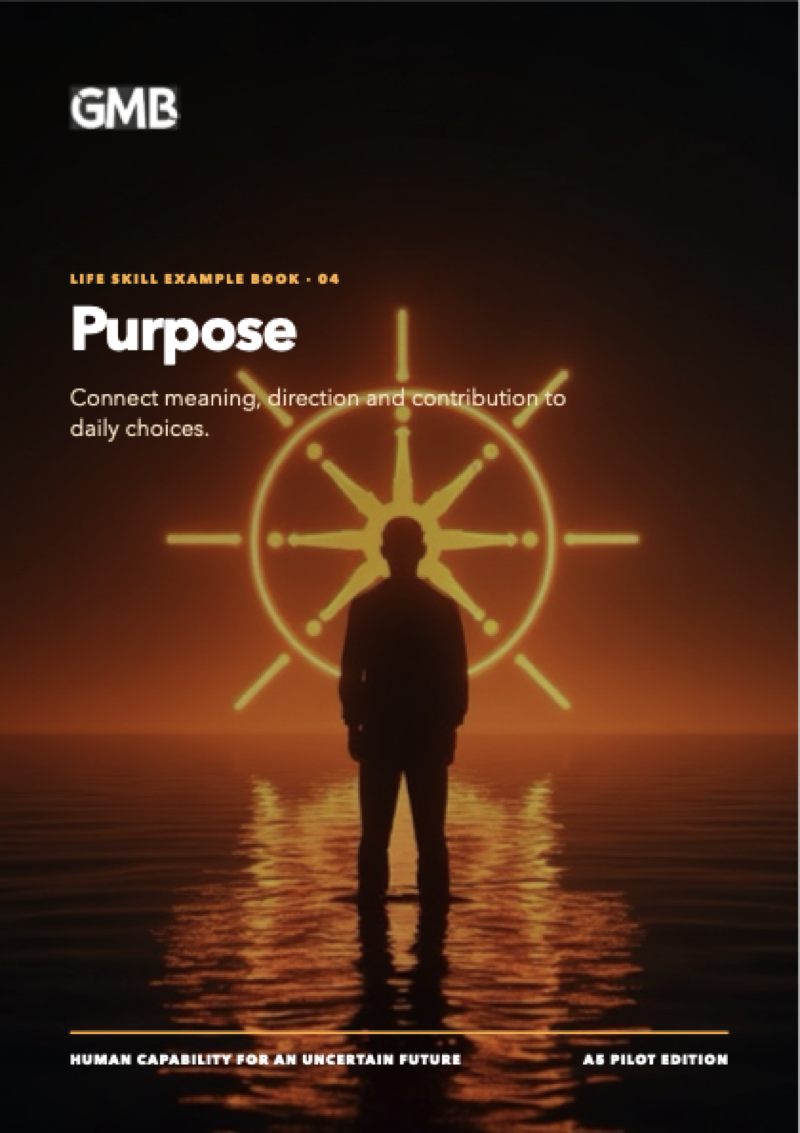
Purpose
The printed A5 field guide — same content, typeset for paper.
Next step
Put this skill into practice
Reading changes what you notice. Practice changes what you do. The seven-day sprint turns one behaviour into a habit.