
Attend · Reflect · Understand
Learn Active Listening
Active listening is the intentional practice of giving full attention, accurately constructing the speaker’s meaning, reflecting content and emotion, exploring before judging, and responding in a way that shows understanding.
Builds your Connection capability.
Start here · one first move
Notice when you begin preparing a reply before the speaker finishes.
Field guide 10
Understand
A working definition
In practice
Pauses competing thoughts, reflects what was heard, checks interpretation, acknowledges emotion and asks before advising or deciding.
Why this matters now
When communication is accelerated, summarized and mediated by tools, human listening preserves nuance, trust, early warning signals and the dignity of being understood.
It is
- Active meaning-making.
- Attentive to words, emotion and context.
- Verified through reflection.
- Completed by an appropriate response.
It is not
- Silent waiting for your turn.
- Agreeing with everything.
- Performing eye contact.
- Immediately fixing the problem.
The capability loop
Listening is a loop of attention and verification.
The speaker’s message is not complete until meaning has been checked.
- 1
Arrive
Set aside the competing task, answer or judgment.
- 2
Receive
Attend to words, tone, pace, emotion and context.
- 3
Reflect
Paraphrase the content and name possible feeling.
- 4
Explore
Ask a question that clarifies meaning or need.
- 5
Respond
Choose acknowledgement, support, challenge or action.
Go deeper
The full field guide
8 connected capabilities+
Attention becomes listening when interpretation is checked.
- Attentiveness
- Sustains focus without preparing the reply.
- Nonverbal engagement
- Uses presence and responsive cues appropriately.
- Comprehension
- Constructs the speaker’s intended meaning.
- Reflection
- Paraphrases and summarizes to verify understanding.
- Inquiry
- Asks relevant questions that deepen clarity.
- Patience
- Allows space, pauses and full expression.
- Empathic response
- Acknowledges emotion and perspective.
- Suspension of judgment
- Delays evaluation until understanding is sufficient.
The components strengthen one another. Development depends on how they are combined in context—not on maximizing one behavior in isolation.
Behaviour map+
01
Before
- Choose presence Stops or postpones competing activity.
- Notice assumptions Names the story already forming about the speaker.
- Check capacity Requests a better time if attention cannot be offered.
- Set the purpose Clarifies whether the conversation seeks thought, care or decision.
02
During
- Stay with the message Returns attention after internal or external distraction.
- Let silence work Allows pauses instead of filling them.
- Reflect and check Offers an interpretation as a question, not a verdict.
- Explore before solving Asks what matters and what kind of response is wanted.
03
After
- Summarize agreement Confirms meaning, ownership and next steps.
- Act on what was heard Lets the conversation influence decisions or support.
- Repair misses Returns when the speaker felt misunderstood.
- Protect confidence Handles personal information with appropriate care.
Case story · composite+
When a performance problem is not what it first seems.
Listening changed the diagnosis.
The challenge.
A manager enters a conversation ready to correct missed deadlines.
The employee appears defensive, and the manager’s first impulse is to explain expectations more firmly. 1 · Hold attention The manager closes the laptop and postpones the prepared solution. 2 · Explore An open question reveals three conflicting priorities and unclear authority. 3 · Acknowledge The manager reflects both the workload facts and the frustration. 4 · Verify The employee corrects one interpretation and names the support actually needed. 5 · Respond They reset priorities, clarify escalation and agree on a short review cycle.
Capability in practice Listening changed the diagnosis.
Without it, the manager would have treated a system problem as an attitude problem.
Leadership and learning culture+
- Model Ask, reflect and show when another perspective changes your view.
- Structure Create forums where quiet, dissenting and affected voices can enter.
- Slow Protect listening before advice, judgment or high-stakes decisions.
- Close Explain what was heard, what will happen and what cannot happen.
- Repair Return openly when people were ignored, misread or harmed.
Why we protect this skill — HI · FRI · IMPACT+
Human Core
How central should human agency, judgment and responsibility remain?
uman owns
▰▰▰▰▰
Future Readiness
How strongly does this help people learn and act as roles and technology change?
Strategic
▰▰▰▰▱
Safeguard Value
How strongly does this protect capability from over-reliance, deskilling and loss of agency?
Critical safeguard
▰▰▰▰▰
They describe why the capability matters—not how advanced a learner is. Tools can transcribe and summarize. Human presence must own interpretation, relational responsibility, repair and the response to another person’s lived experience.
Practice
Make the person feel HEARD.
Use this short structure in real work, reflection or coaching. Keep the action specific enough to observe.
- H
Hold attention
What must I pause so I can be present?
- E
Explore
What meaning, context or need is not yet clear?
- A
Acknowledge
What content and emotion can I name tentatively?
- R
Reflect How will
I check that my interpretation is accurate?
- D
Decide response
Does this need witness, support, challenge or action?
One-minute start: “What I hear you saying is … Have I understood that correctly?” The protocol supports practice. It does not remove the need for context, expertise, ethical judgment or appropriate human support.
Seven-day experiment
Practise one listening behavior each day.
0 of 7 days marked · saved on this device
Prove it
Five stages of listening presence.
The progression measures observable attention, accuracy, inquiry and relational impact—not quietness or compliance.
L1
Attend
Reduces obvious distraction and lets the speaker finish with support.
L2
Reflect
Paraphrases key content and asks a relevant clarifying question.
L3
Explore
Accurately reflects content and emotion across everyday contexts.
L4
Integrate
Holds complexity, tension and multiple perspectives without rushing.
L5
Enable
Creates conditions where others feel safe to speak, understand and repair.
Use the progression well Ask for the next observable behavior—not a label for the person.
Ask Markku-AI about Active Listening
Markku-AI is trained on Markku Pelkonen's own work: life skills, future-readiness, and how any skill actually develops. Ask it about a skill you want to build. For questions about how this website works, the answers above are better.
Read the full minibook
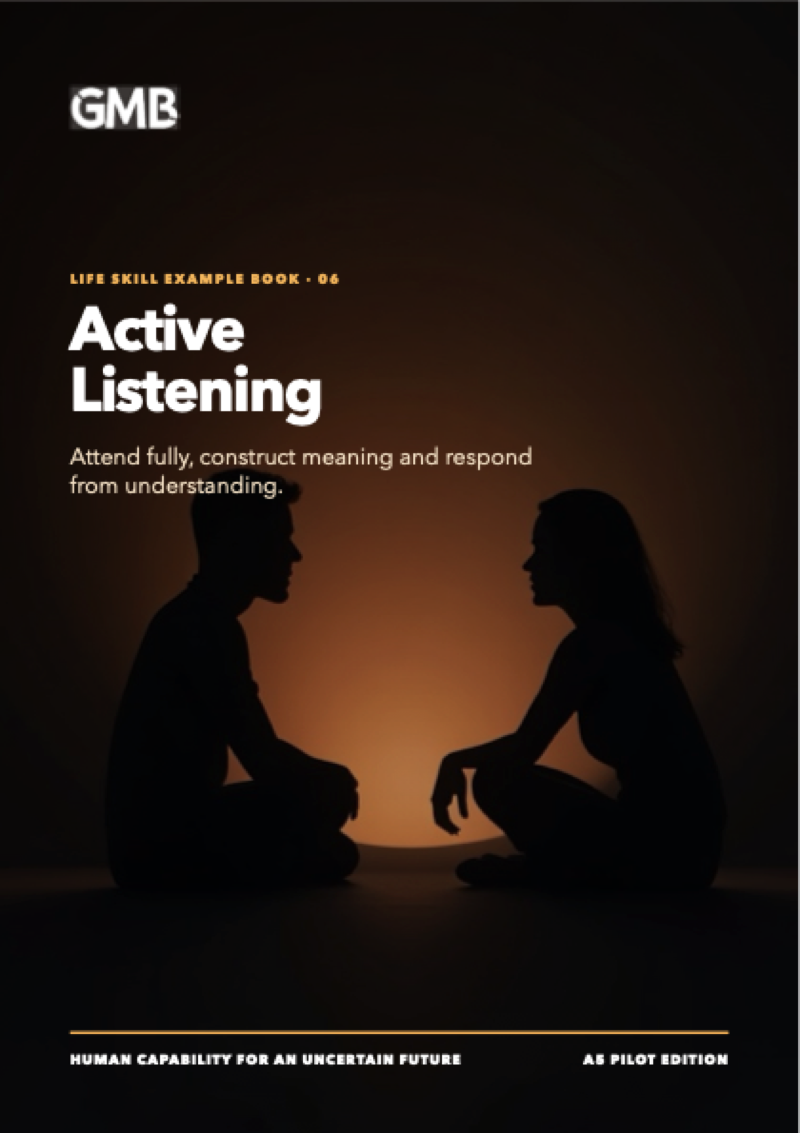
Active Listening
The printed A5 field guide — same content, typeset for paper.
Next step
Put this skill into practice
Reading changes what you notice. Practice changes what you do. The seven-day sprint turns one behaviour into a habit.