
Direct · Monitor · Adapt
Learn Learning to Learn
Learning to Learn means taking charge of the process.
Builds your Learning Agility capability.
Start here · one first move
Choose one capability and define what competent performance looks like.
Field guide 06
Understand
A working definition
In practice
States a learning goal, tests current understanding, chooses a method, checks evidence, changes strategy and applies the learning elsewhere.
It is
- Active and self-regulated.
- Visible through learning behaviors.
- Built through feedback and reflection.
- Transferable across roles and domains.
It is not
- Consuming more content.
- Relying on one preferred style.
- Knowing every answer.
- Letting a tool do the thinking and checking.
- The decisive shift Move from “Did I finish the course?” to “What can I now explain, perform, adapt and use without hidden support?” Learning becomes durable when confidence is calibrated against evidence—not against familiarity or speed.
The capability loop
Good learners do not only work harder. They steer.
- 1
Frame
What capability or outcome matters—and why?
- 2
Activate What do
I already know?
- 3
Practise
Retrieve, explain, perform and receive feedback.
- 4
Monitor
What evidence shows understanding or confusion?
- 5
Adapt
Change the strategy and transfer learning to a new context.
Go deeper
The full field guide
Eight connected capabilities+
Awareness becomes useful when it changes action.
- Metacognitive awareness
- Notices how thinking and learning are working.
- Strategy selection
- Matches the method to the learning task.
- Self-assessment
- Calibrates confidence against evidence.
- Goal setting
- Defines a meaningful capability and success criteria.
- Resource management
- Uses time, people, tools and information deliberately.
- Self-regulation
- Manages attention, effort, emotion and persistence.
- Transfer
- Applies learning across situations and domains.
- Learning motivation
- Sustains curiosity, purpose and confidence.
The components reinforce one another: accurate self-assessment improves strategy choice; feedback improves calibration; transfer reveals what was truly learned.
Behaviour map+
01
Before
- Defines performance Names what they need to explain, do or adapt.
- Activates prior knowledge Retrieves what is already known before adding information.
- Chooses a strategy Matches reading, retrieval, modelling or practice to the task.
- Designs conditions Protects attention and identifies resources and support.
02
During
- Works from memory Explains or performs before checking the answer.
- Monitors confusion Notices gaps, errors and unproductive effort.
- Uses feedback Seeks evidence that can improve the next attempt.
- Regulates effort Adjusts attention, emotion, pace and support.
03
After
- Tests independence Performs without prompts or hidden tool support.
- Calibrates confidence Compares felt fluency with actual performance.
- Transfers learning Uses the capability in a changed situation.
- Updates the loop Records what worked and what the next practice needs.
Case story · composite+
When the role changes faster than the manual.
Use AI to strengthen the loop—not replace it.
The challenge.
Mira must learn an unfamiliar AI-supported analysis workflow while continuing her client work.
The available training explains features but not judgment. 1 · Define performance She translates “learn the tool” into three observable tasks and quality criteria. 2 · Pre-test She attempts a realistic case first, exposing gaps in both domain reasoning and tool use. 3 · Choose strategies She studies one worked example, retrieves the logic from memory and practises on a new case. 4 · Give AI a bounded role AI generates questions, counterexamples and feedback prompts.
Mira makes and verifies the decisions. 5 · Transfer and teach She applies the workflow to a different client context, documents failure points and teaches a peer.
Learning in practice Success is not faster output.
It is independent, adaptable performance with transparent support.
Leadership and learning culture+
- Model Make learning decisions visible.
- Protect Create time and attention for practice.
- Scaffold Connect goals, practice, feedback and transfer.
- Reward Value questions, calibration and updating.
- Connect Turn learning into shared capability.
Why we protect this skill — HI · FRI · IMPACT+
Human Core
How central should human agency, judgment and responsibility remain?
uman owns
▰▰▰▰▰
Future Readiness
How strongly does this help people learn and act as roles and technology change?
Foundational
▰▰▰▰▰
Safeguard Value
How strongly does this protect capability from over-reliance, deskilling and loss of agency?
Critical safeguard
▰▰▰▰▰
They describe why the skill matters—not how advanced a learner is. AI can support practice, feedback and access. The learner must still own the goal, evidence, strategy choice and transfer.
Practice
LEARN with evidence.
Use for a new role, method, concept or tool. Keep the loop small enough to repeat.
- L
Locate What can
I do now?
- E
Establish
What outcome matters?
- A
Apply
Which strategy fits?
- R
Review
What does the evidence show?
- N
Next
What changes in the next attempt?
Seven-day experiment
Run one complete learning loop.
0 of 7 days marked · saved on this device
Prove it
Five stages of learning agency.
The stages describe increasingly independent, evidence-informed and socially enabling behavior. They are separate from the three strategic signals.
L1
Notice
Names a learning need and describes what is difficult with support.
L2
Choose
Sets a simple goal, uses a familiar strategy and finds an obvious resource.
L3
Regulate
Monitors understanding, manages effort, uses feedback and changes approach.
L4
Transfer
Calibrates self-assessment, combines strategies and applies learning across contexts.
L5
Enable
Creates learning opportunities, shares metacognitive practice and strengthens learning culture.
Use the progression well Look for evidence of agency: goal choice, strategy adjustment, calibration and transfer.
Ask Markku-AI about Learning to Learn
Markku-AI is trained on Markku Pelkonen's own work: life skills, future-readiness, and how any skill actually develops. Ask it about a skill you want to build. For questions about how this website works, the answers above are better.
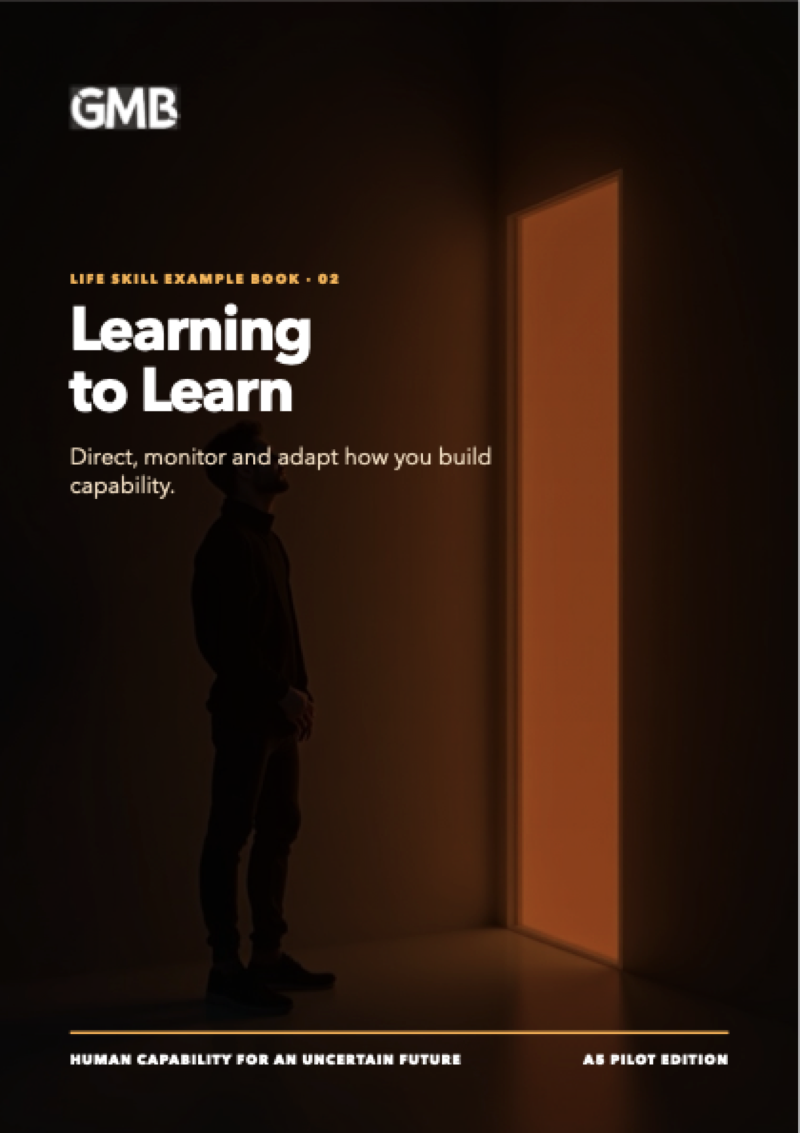
Read the full minibook
Learning to Learn
The printed A5 field guide — same content, typeset for paper.
Next step
Put this skill into practice
Reading changes what you notice. Practice changes what you do. The seven-day sprint turns one behaviour into a habit.